
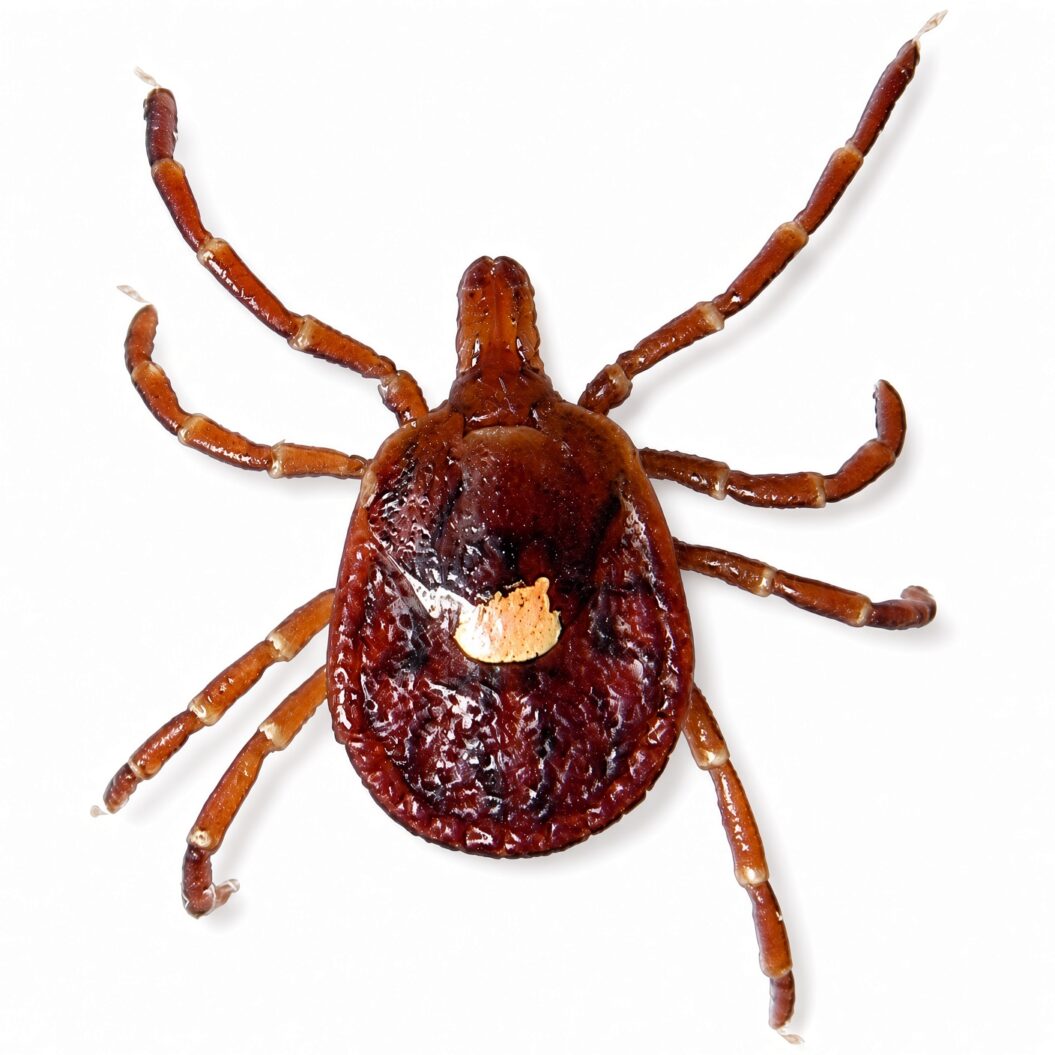
The lone star tick — the female’s single white dot makes her easy to identify. This is the tick behind most of Missouri’s tick-borne illness.
Summer in the Ozarks brings lake days, hiking, yard work — and ticks. Every year patients come in worried after finding one attached, and the first question is almost always the same: “Can I get Lyme disease here?”
It is a fair question, and the answer surprises people.
Lyme disease is genuinely rare in Missouri
In 2023, the most recent year with state-level CDC data, Missouri reported 15 Lyme disease cases — roughly 0.2 per 100,000 residents. Nationally there were about 89,000. Missouri is consistently among the lowest-incidence states in the country.
Two things worth knowing about those numbers. First, the CDC changed how Lyme cases are counted in 2022, so figures before and after that year are not directly comparable — national totals jumped, but that was mostly a change in reporting method rather than a change in risk. Missouri’s count actually went down. Second, many Lyme infections diagnosed in Missourians were acquired while travelling to the Northeast or upper Midwest, where the blacklegged tick that carries the Lyme bacterium is well established.
So if you are worried after a tick bite in Taney or Stone County, Lyme is not the most likely concern.
But our ticks are not harmless
Missouri has plenty of its own tick-borne illness, and in some cases we are a national hotspot:
- Ehrlichiosis — carried by the lone star tick. Missouri has reported roughly half of all U.S. cases of one common form, the highest incidence in the nation.
- Tularemia — Missouri accounts for about 11% of all U.S. cases.
- Rocky Mountain spotted fever — still present here, and still the one that can turn serious fastest.
- Heartland virus and Bourbon virus — both newer, both first identified in Missouri, both spread by the lone star tick. Cases are rare, but Missouri sees them; the state’s 2025 Heartland virus case was in Greene County, just up the road.
- STARI (southern tick-associated rash illness) — see below.
The bull’s-eye rash that isn’t Lyme
STARI follows the bite of a lone star tick and produces a rash that looks a great deal like the Lyme bull’s-eye. We know which tick is involved — what we still don’t know is what actually causes it. That is why there is no blood test for STARI, and why a Missouri patient can have a convincing bull’s-eye rash and still test negative for Lyme. It doesn’t mean the test was wrong.
Alpha-gal: the one nobody saw coming
Alpha-gal syndrome is an allergy to red meat and other mammal products that can develop after a lone star tick bite. It was barely on the radar when we first wrote this, and Missouri turns out to be one of the most affected states. The reaction is often delayed by several hours after eating, which makes it easy to miss. If you have started having hives, stomach upset, or worse in the middle of the night after a beef or pork dinner, mention the tick bite — it changes what we test for.
When a tick bite should prompt a call
Contact us if, in the days to weeks after a known bite, you develop:
- Fever or chills
- Headache, fatigue, muscle aches, nausea, or diarrhea
- A rash — especially an expanding one, or one that spreads to the palms and soles
Preventing the bite in the first place
- Use an EPA-registered repellent with DEET on skin.
- Treat clothing, boots, and gear with permethrin — on fabric only, never on skin, and let it dry fully.
- Tuck pants into socks, wear long sleeves, and walk the center of the trail away from brush and tall grass.
- Shower within two hours of coming inside.
- Do a full-body tick check daily. (I’m pretty sure Brad Paisley wrote a song about this…) Don’t forget behind the knees, the waistband, the hairline, and the armpits.
- Check pets too — they carry ticks indoors.
How to remove a tick
Use fine-tipped tweezers. Grasp the tick as close to the skin as you can and pull straight up with steady, even pressure. Don’t twist, and skip the folk remedies — petroleum jelly, nail polish, and hot matches don’t work and waste time while the tick stays attached. Clean the bite afterward, and note the date on your calendar so you know the window to watch.
Peace of mind is priceless
That is what I tell patients, and I mean it. If you have been bitten and you are worried, contact your health care provider — we can help you sort out whether testing is needed and which testing makes sense, because it differs by illness. We are glad to help if you need us, and a virtual visit works fine for talking through a tick bite if that is easier for your family. Call (417) 332-3639.
As always, I hope you stay happy and healthy.